New Jersey energy and utility bill assistance: LIHEAP, USF and weatherization (2027)
The New Jersey Department of Community Affairs (DCA) runs the federal Low Income Home Energy Assistance Program (LIHEAP) and the state's Universal Service Fund (USF) on a single application, open October 1, 2026 to June 30, 2027 while funds last. Both use 60% of state median income, $98,602 a year for a family of four in FFY 2027, and DCA decides eligibility itself instead of leaving it to county offices.
Figures apply to FFY 2027 (October 1, 2026 to September 30, 2027)
Contents12 sections
Key takeaways
- LIHEAP and USF share one income limit for FFY 2027: 60% of state median income, $98,602 a year or $8,217 a month for a household of four 2.
- The FFY 2027 heating benefit runs from $118 to $1,278, and households in Warren and Sussex counties get a higher grid than the other 19 counties 45.
- Applications are accepted October 1, 2026 to June 30, 2027 on a first-come, first-served basis, so the program can close earlier if money runs out 24.
- USF adds a monthly gas and electric credit of $20 to $200, and first-time enrollees with a $60+ past-due balance are placed in Fresh Start for arrears forgiveness 910.
- From November 15 to March 15, LIHEAP, USF, SSI, TANF, PAAD and Lifeline recipients, and customers who self-certify hardship, can block gas and electric shutoffs 10.
Quick facts
| Administered by | NJ Department of Community Affairs (DCA), with 20 local partnering agencies 4 |
|---|---|
| Income limit (LIHEAP and USF) | 60% of state median income: $67,049 for 2, $98,602 for 4 (FFY 2027) 2 |
| Heating benefit | $118 to $1,278, one payment per season 4 |
| Emergency help | Up to $800, plus up to $100 for reconnection; 48 hours, or 18 if life-threatening 3 |
| Application window | October 1, 2026 to June 30, 2027, while funds last 2 |
| Yearly cap | $4,878 in total LIHEAP benefits per household 3 |
| Where to apply | DCAid online, a county partnering agency, or the 800-510-3102 hotline 1 |
Programs at a glance
| Program | Type | Help available | Status |
|---|---|---|---|
| Low Income Home Energy Assistance Program (LIHEAP): heating assistanceNew Jersey Department of Community Affairs, Division of Housing and Community Resources, with local partnering agencies | Voucher/subsidy | One heating benefit of $118 to $1,278 for FFY 2027, set by income, household size, fuel type and region; paid to the utility or by check | Seasonal (Oct 1, 2026 to Jun 30, 2027, first come, first served) |
| LIHEAP medically necessary cooling assistanceNew Jersey Department of Community Affairs | Voucher/subsidy | $300 one-time benefit with a doctor's certification or utility Critical Care form | Seasonal (Oct 1, 2026 to Jun 30, 2027, funds limited) |
| LIHEAP emergency energy assistance and emergency furnace repairNew Jersey Department of Community Affairs, with local partnering agencies | Voucher/subsidy | Up to $800 for fuel or to restore utility service, plus up to $100 reconnection; furnace repair or replacement up to $2,000 for homeowners | Seasonal (December to June 30; gas and electric after March 15) |
| Universal Service Fund (USF)New Jersey Board of Public Utilities, administered by the Department of Community Affairs | Bill credit | Monthly credit of $20 to $200 on gas and electric bills combined, based on energy burden | Open (year-round; shares the LIHEAP application) |
| USF Fresh StartRegulated gas and electric utilities, with Board of Public Utilities oversight | Bill credit | Forgiveness of a past-due balance of $60 or more, 1/12 for each month the current bill is paid in full; once every five years | Automatic with first USF enrollment |
| Weatherization Assistance Program (WAP)New Jersey Department of Community Affairs, through county WAP agencies | Free service | Energy audit, insulation, air sealing and heating system work; LIHEAP-funded work capped at $13,487 per home | Open (year-round, waiting lists ranked by priority) |
| Lifeline Utility AssistanceNew Jersey Department of Human Services, Division of Aging Services | Bill credit | $225 a year as a gas or electric credit, or a $225 check for tenants with utilities in the rent | Open (for PAAD-eligible older adults and people with disabilities) |
Income limits
LIHEAP and USF: 60% of New Jersey state median income (gross income), effective FFY 2027 (October 1, 2026).2
| Household | 1 | 2 | 3 | 4 | 5 | 6 | 7 | 8 |
|---|---|---|---|---|---|---|---|---|
| Per year | $51,273 | $67,049 | $82,825 | $98,602 | $114,378 | $130,154 | $133,112 | $136,070 |
DCA tests eligibility on gross monthly income: $8,217 a month for four. Its chart continues to 12 people ($147,903), then adds $2,952 a year for each extra person.
New Jersey’s LIHEAP is run centrally by DCA’s Division of Housing and Community Resources. The FFY 2027 State Plan lists DCA as the agency that decides eligibility and pays gas, electric and bulk-fuel vendors for heating, cooling and crisis help. The local partnering agencies take applications and check documents 4. The plan budgets 65% of the grant for heating, 10% for winter crisis help, 5% for medically necessary cooling, 5% for weatherization, 3% for energy-need services, 2% for carryover and 10% for administration 4.
One DCAid application, four benefits
The FFY 2027 form doubles as an application for the Universal Service Fund, and you can receive both at the same time 2. The same form also lets you ask for weatherization 8. Online, everything runs through DCAid, which shows the LIHEAP and USF 2027 season as open and the weatherization portal as open all year 6.
Households that get SNAP, TANF or PAAD may never need to apply. DCA receives their data from the Department of Human Services each September and quarterly after that, and enrolls them every year 4. The handbook says a separate application from a household already getting an automatic payment will be denied. If the automatic data has errors, submit a full application instead 3.
Two groups are excluded even when income qualifies: residents of public housing and households with a rent subsidy that covers all heating costs, unless they pay a fuel supplier directly 2. Households made up only of students claimed as tax dependents by someone else are also excluded 3.
The 60% of state median income test for FFY 2027
Federal law caps LIHEAP eligibility at the greater of 150% of the poverty guidelines or 60% of state median income 15. New Jersey uses the higher measure, 60% of SMI, for heating, cooling, crisis and LIHEAP-funded weatherization 4. USF uses the same limit 9.
The test uses gross monthly income: $4,273 a month for one person, $6,902 for three and $8,217 for four 2. Income is verified with pay stubs or other records covering any four straight weeks in the 60 days before you sign 3. New Jersey has no asset test 3. Some income is not counted. Examples are Social Security paid for children under 18, veterans benefits, SNAP, scholarships of students still in school, and benefits from USF, Lifeline and SHARES programs 3.
If no one in the household has income, the head of household files a zero-income declaration and a Monthly Household Expenses Form. Households reporting under $500 a month must also show how they are getting by 3. Each household member must give a Social Security number or proof of applying for one 3. A household member who is not a qualified immigrant is left out of the household size. Any monthly income they have above $500 still counts 3.
The Board of Public Utilities’ program page still shows $96,165 for a family of four, which is the prior-year limit. DCA’s FFY 2027 fact sheet is the current one 210.
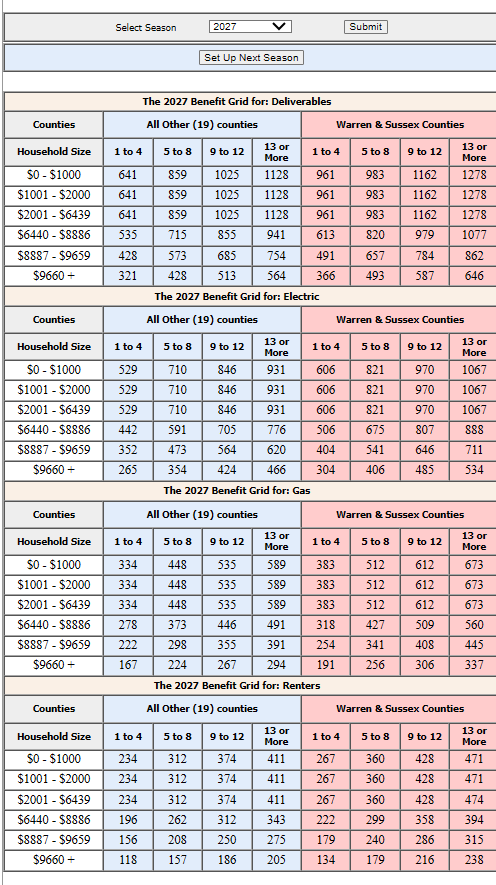
Reading DCA’s FFY 2027 heating benefit grid
Your heating benefit is one payment for the season. It depends on income, household size, fuel type and region 2. DCA’s grid splits the state into two heating regions: Warren and Sussex counties in the northwest, and the other 19 counties 5. Gas and electric benefits go straight to the utility as a credit. Oil, propane and other delivered fuels are paid by a two-party check made out to you and your supplier. If heat is included in your rent, you get a one-party check 2.
| Fuel type | 1-4 people, 19 other counties | 1-4 people, Warren and Sussex | 13+ people, 19 other counties | 13+ people, Warren and Sussex |
|---|---|---|---|---|
| Oil, propane and other delivered fuels | $641 | $961 | $1,128 | $1,278 |
| Electric heat | $529 | $606 | $931 | $1,067 |
| Natural gas heat | $334 | $383 | $589 | $673 |
| Heat included in rent | $234 | $267 | $411 | $471 |
Scroll the table sideways to see every column.
Source: FY2027 Benefit Matrix 5. Benefits step down in the $6,440 to $8,886, $8,887 to $9,659 and $9,660-and-over ranges. The grid does not state a time period for these ranges; they line up with the gross monthly income DCA uses to test eligibility 3.
At the top income range, a household of one to four in the 19 other counties gets $321 for delivered fuel, $265 for electric heat, $167 for gas and $118 if heat is in the rent 5. The $118-to-$1,278 range matches the State Plan’s minimum and maximum 4. All LIHEAP help combined, including emergency and furnace payments, is capped at $4,878 per household for the year 3.
Cooling, emergency fuel and furnace help between October and June
Medically necessary cooling. Cooling is not a general summer program in New Jersey. Households pay a one-time $300 benefit only if a licensed medical practitioner certifies that a household member’s health is at serious risk without cooling, or if they have a utility-approved Critical Care form 3. Apply for it with the heating application 8. It is credited to an active electric account or paid by check 2.
Emergency energy assistance. An emergency exists when you are without heat or about to be, or when a renter who pays heat through the rent receives a shutoff notice 3. DCA allows up to $800 for the first fuel purchase or to restore or keep utility service, plus up to $100 for reconnection 3. Help must arrive within 48 hours of the request, or 18 hours if the situation is life-threatening 3. Emergency help runs from December through June 30. Gas and electric emergencies open only after the winter shutoff protection ends on March 15 3. DCAid lists a non-heating electric emergency benefit of up to $300 for renters, reduced because of federal funding cuts 6.
Furnace repair and replacement. Homeowners who live in the home can get emergency furnace repair or replacement up to $2,000, plus up to $100 to restart a furnace. DCA must approve the work in writing before it starts 34.
Spring shutoffs. Money left over from the regular season pays a supplemental heating emergency benefit. It goes to gas or electric heating households that face a shutoff or shutoff notice between March 16 and June 30 and have made a good-faith payment 3.
Applying through DCAid or one of the 20 partnering agencies
The State Plan says DCA cut its local partnering agencies from 31 to 20 after a competitive bid for FFY 2026 4. Each agency must serve a whole county, and some cover several. Gather everything before you start, because applications are first come, first served and an incomplete file loses your place 6.
Check your income against the fact sheet
Compare your household’s gross monthly income with DCA’s FFY 2027 chart 2. DCAid also has an anonymous screening tool for other DCA programs 1.
Choose how to apply
Apply online through DCAid, or download the paper form and take or mail it to the agency on DCA’s county list 17. Households aged 60 or older and people with disabilities can apply by mail or call NJ 211 to request a home visit 3.
Collect documents
NJ 211 lists Social Security cards for every member, proof of income for everyone 18 or older, and proof of citizenship or legal status. You also need a recent bill from your main heating supplier, recent electric and gas bills (all pages), and a lease or Tenant Verification Form 8. A lease within six months of expiring needs a current rent receipt 3.
Ask about emergencies right away
If you are out of fuel or have a shutoff notice, tell the agency or hotline at intake so the 48-hour or 18-hour clock starts 3.
Track the decision
DCA must decide within 60 days of a complete application, and NJ 211 says processing takes about that long 38. Returning online applicants can check status in DCAid, or call 2-1-1 or 800-510-3102 8.
Respond to requests for documents
After three contacts over 70 days without the missing items, the application is deactivated and you must reapply 3.
Recertify every fall
Recertification instructions go out in late September or early October 8. USF can take up to 90 days, so DCA advises renewing at least three months before your credit expires 9.
Weatherization through DCA’s county WAP agencies
The Weatherization Assistance Program is free and does not pay bills. It improves heating system efficiency and cuts energy loss 11. DCA’s policy manual sets income eligibility at 200% of the federal poverty guidelines. The chapter reissued in April 2025 still shows the 2025 figures, such as $64,300 for four 12. Households on TANF, SNAP or LIHEAP, among others, are categorically eligible 12. The State Plan adds that any household found eligible for LIHEAP qualifies, provided the building passes the energy audit and has not been weatherized in the past 15 years 4.
LIHEAP-funded work is capped at $13,487 per home, with a planned average of $8,547 4. Renters need written consent from the landlord 4. Waiting lists are ranked by points for a child under 7, older or disabled members, and high energy burden 12. Apply through the WAP agency DCA lists for your county, or through the DCAid weatherization portal 611.
USF credits, Lifeline and the November 15 to March 15 shutoff shield
USF. The Board of Public Utilities created USF, and DCA runs it 9. It covers the part of your gas and electric costs above 2% of income for each service, or 4% for electricity if you heat with it. Benefits range from $20 to $200 a month combined 9. Only customers of the seven regulated gas and electric utilities qualify, not municipal utilities 89. First-time USF customers with past-due balances of $60 or more are automatically enrolled in Fresh Start. Each month you pay the current bill in full, 1/12 of the old balance is forgiven. Fresh Start is available once every five years 10.
Lifeline Utility Assistance. This DHS program pays $225 a year to people who receive or qualify for PAAD. For 2026, that means age 65 or older, or 18 to 64 and receiving Social Security Disability, with income under $54,943 if single or $62,390 if married 13. Gas and electric customers get the benefit as a bill credit, and tenants with utilities in the rent get a check. SSI recipients get it in their SSI check and should not apply 13.
PAGE. If your income is too high for USF or you still need help, the Payment Assistance for Gas and Electric program is run by SHARES with state Treasury money while funds last. The BPU lists its limit as $160,276 for a household of four 10. USF and PAGE do not require a Social Security number 10.
Winter Termination Program. From November 15 to March 15, regulated gas and electric utilities cannot shut off customers who receive LIHEAP, USF, Lifeline, TANF, SSI, PAAD or General Assistance. The same protection covers customers who self-certify that they cannot pay because of job loss, illness, medical bills or a death in the family 10. Call your utility to request it 10. DCA runs a matching program for municipal utilities, local authorities and rural electric cooperatives 14. If you are already disconnected, a utility can restore service when you show a USF, LIHEAP or PAGE application and pay up to 25% of the balance 10.
Appealing a DCA energy decision
You can request a review if DCA denies a complete application, gives less than you expected, or does not decide in time. The deadline is 60 days, or 30 days for older adults and people with disabilities 3. DCA first does an administrative review and sends the result in writing. If you disagree, the case goes to a fair hearing under Work First New Jersey hearing rules (N.J.A.C. 10:90-9.3) 3. Every benefit notice explains how to file 4.
For other New Jersey help, see the New Jersey assistance hub, or compare limits on the energy and utility assistance page.
Verified resources
Where to apply
- DCAid online application (LIHEAP, USF and Weatherization) dcaid.dca.nj.govRegister, complete one application for all three programs and upload documents. Returning applicants sign in here to check status.
- DCA list of local LIHEAP/USF application agencies by county nj.govAddresses, phone numbers and hours for in-person or mail applications, plus each county's utility contacts.
- NJ 211 Home Energy Assistance Hotline nj211.orgDial 2-1-1 or 800-510-3102, Monday to Friday 8am to 8pm, for application help, status checks or a home visit.
- DCA Weatherization Assistance Program agencies nj.govContact the WAP agency listed for your county, or check the weatherization box on the DCAid application.
- NJSave application for Lifeline (and PAAD) nj.govOlder adults and people with disabilities who are not already PAAD members apply through NJSave; hotline 1-800-792-9745.
Sources
- 1
- 2
- 3
- 4
- 5 New Jersey Department of Community Affairs, FY2027 Benefit Matrix Checked Oct 20, 2026 · Back to text ↑
- 6
- 7
- 8
- 9 New Jersey Department of Community Affairs, FAQ: Universal Service Fund (USF) Checked Oct 20, 2026 · Back to text ↑
- 10 New Jersey Board of Public Utilities, Utility Assistance Programs Checked Oct 20, 2026 · Back to text ↑
- 11 New Jersey Department of Community Affairs, Weatherization Assistance Program Checked Oct 20, 2026 · Back to text ↑
- 12
- 13
- 14 New Jersey Department of Community Affairs, Winter Termination Program Checked Oct 20, 2026 · Back to text ↑
- 15
Was this information accurate? Report an error
More help in New Jersey
- First-Time Homebuyer GrantsNJHMFA Down Payment Assistance Program (Smart Start)
- Small Business GrantsSmall Business Fund
- Cash AssistanceWork First New Jersey/Temporary Assistance for Needy Families (WFNJ/TANF)
- Childcare AssistanceChild Care Assistance Program (CCAP)
- Student and Vocational GrantsTuition Aid Grant (TAG)
Energy and Utility Assistance in other states: Alabama, Alaska, Arizona, Arkansas, California, Colorado, Connecticut, Delaware, Florida, Georgia, Hawaii, Idaho, Illinois, Indiana, Iowa, Kansas, Kentucky, Louisiana, Maine, Maryland, Massachusetts, Michigan, Minnesota, Mississippi, Missouri, Montana, Nebraska, Nevada, New Hampshire, New Mexico, New York, North Carolina, North Dakota, Ohio, Oklahoma, Oregon, Pennsylvania, Rhode Island, South Carolina, South Dakota, Tennessee, Texas, Utah, Vermont, Virginia, Washington, West Virginia, Wisconsin, Wyoming. Compare all states.